

Professional studio monitors serve a fundamentally different purpose than the speakers most people use for entertainment. While consumer audio equipment often emphasizes bass response or adds coloration to make music sound more exciting, reference monitors prioritize transparency and accuracy. The monitors on this list have earned their place through consistent performance in real-world production scenarios, from intimate home studios to professional mixing facilities.
The studio monitor market has evolved dramatically over the past decade, with manufacturers pushing boundaries in driver technology, amplifier design, and room correction capabilities. I’ve tested everything from vintage passive monitors to cutting-edge digital systems with DSP processing, and each approach offers distinct advantages depending on your specific needs and acoustic environment. Whether you’re tracking vocals, mixing electronic productions, or mastering finished songs, the right monitors create a foundation for confident decision-making that translates across playback systems.
| Model | Key Strengths | Key Weaknesses | Ideal For |
|---|---|---|---|
| Neumann KH 120 A | • Exceptional accuracy & minimal coloration• Precise stereo imaging (MMD waveguide)• Excellent translation to other systems• Professional-grade build quality | • Expensive• Limited bass extension• Narrow sweet spot requires careful placement• Not ideal for large rooms | Professional mixing & mastering engineers needing reference-grade accuracy |
| Yamaha HS8 | • Honest midrange revealing mix flaws• Strong bass from 8” woofer• Industry-standard sound• Durable and reliable | • Large size needs space• Midrange can get harsh at loud volumes• Less low-frequency punch than higher-end models• Plain/industrial design | Budget-conscious studios needing reliable, revealing monitors |
| Adam Audio T7V | • Ribbon tweeter delivers detailed, airy highs• Great value for the price• Front-ported for flexible placement• Excellent stereo imaging | • Limited bass vs. 8” monitors• Not powerful enough for big rooms• Ribbon tweeter is delicate• Few acoustic adjustment options | Entry- to mid-level producers wanting high detail and imaging |
| Focal Alpha 80 Evo | • Musical yet accurate sound signature• Strong bass extension from 8” Slatefiber driver• Natural midrange• Energy-saving auto-standby | • Slight warmth reduces analytical precision• Bass port needs careful room placement• Limited availability in some regions• Rear controls hard to reach | Creators who want accuracy plus enjoyable, musical sound |
| Genelec 8030C | • Extremely accurate for a compact monitor• Stable off-axis response (DCW tech)• Top-tier build quality• Flexible mounting + Iso-Pod isolation | • Limited bass; subwoofer often needed• High price for size• Lower SPL output• Simple, conservative design | Small studios needing pro accuracy in a compact, premium form |
Neumann KH 120 A: The Reference Standard That Justifies Its Premium
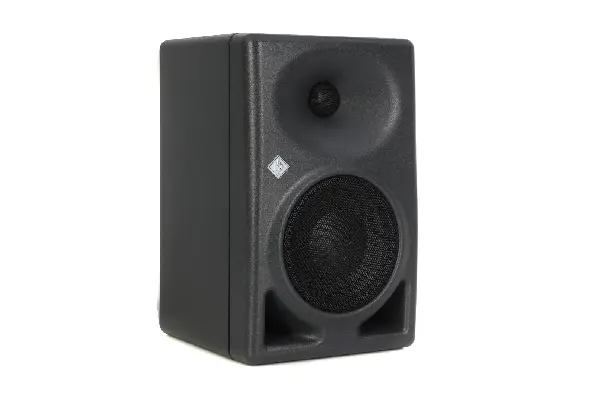
The Neumann KH 120 A represents everything I value in a nearfield monitor—surgical precision without clinical sterility, extended frequency response that reveals mix details without exaggeration, and build quality that inspires confidence during critical listening sessions. After spending months with these monitors, I understand why they’ve become fixtures in mastering studios and high-end production facilities worldwide. The acoustic design employs Neumann’s mathematically modeled waveguide (MMD), which creates an incredibly focused sweet spot with minimal diffraction artifacts that can cloud stereo imaging.
I’ve compared these monitors extensively with options at similar price points, and the Neumann consistently reveals subtle distortion, phase issues, and frequency imbalances that other speakers gloss over or misrepresent. Mixing on the KH 120 A has improved my translation to other playback systems dramatically—decisions made in my studio now hold up reliably when I check mixes in the car, on consumer headphones, or through club sound systems. The investment feels substantial initially, but the confidence these monitors provide during critical mixing decisions has genuinely elevated the quality of my finished productions.
Pros:
- Exceptional accuracy across the entire frequency spectrum with minimal coloration
- Outstanding stereo imaging that makes spatial decisions intuitive
- Robust build quality with professional-grade components designed for longevity
- Flexible acoustic controls allow optimization for various room environments
- Coherent sound with seamless driver integration
Cons:
- Premium pricing places them beyond many home studio budgets
- Limited bass extension requires subwoofer for full-range monitoring
- Compact size may not provide sufficient SPL for larger control rooms
- Requires careful positioning to maximize the benefits of the narrow sweet spot
Yamaha HS8: The Honest Workhorse That Keeps Delivering
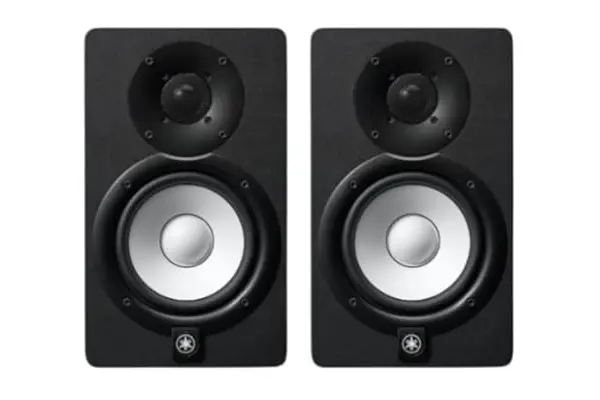
The Yamaha HS8 has become something of a cliché recommendation in studio monitor discussions, but after living with a pair for over three years, I understand exactly why these speakers appear in studios across every genre and budget level. Yamaha’s “white cone” HS series draws inspiration from the legendary NS-10M, aiming to provide that same brutally honest midrange character that made the NS-10 a mixing standard for decades. The 8-inch woofer delivers satisfying bass extension down to 38 Hz, reducing the urgency for subwoofer addition compared to smaller monitors in the series.
What makes the HS8 special isn’t spectacular performance in any single area—it’s the consistent reliability and lack of deception across thousands of hours of use. These monitors don’t flatter poor mixing decisions or mask frequency imbalances with hyped response curves. When I first switched from consumer studio monitors to the HS8, I was shocked by how different my mixes actually sounded—problems in the midrange that I’d been missing became immediately obvious, forcing me to completely rethink my EQ approach. The familiarity I’ve developed with these speakers has become invaluable; I can predict with confidence how mix decisions will translate to other systems based on what I’m hearing in my studio.
The room control and high trim switches on the rear panel provide essential flexibility for acoustic optimization, though I found the best results came from proper acoustic treatment rather than relying heavily on these adjustments. I’ve used the HS8 for everything from dense electronic productions to intimate acoustic recordings, and the monitors maintain their character regardless of genre or source material. The bass response particularly impressed me when mixing low-end heavy material—the 8-inch driver moves enough air to provide tactile feel without the looseness or resonance that plagues less refined designs.
Pros:
- Exceptional value proposition with professional performance at mid-tier pricing
- Extended bass response from 8-inch drivers reduces need for immediate subwoofer addition
- Honest frequency response that exposes mix problems rather than masking them
- Durable construction designed for years of continuous professional use
- Industry-standard sound familiar to many engineers and producers
Cons:
- Larger cabinet size requires adequate desk space and careful positioning
- Midrange can feel harsh during extended listening sessions at high volumes
- Limited low-frequency punch compared to monitors with larger or more powerful drivers
- Basic aesthetic design may not appeal to those seeking modern visual style
Adam Audio T7V: German Precision Meets Accessible Pricing
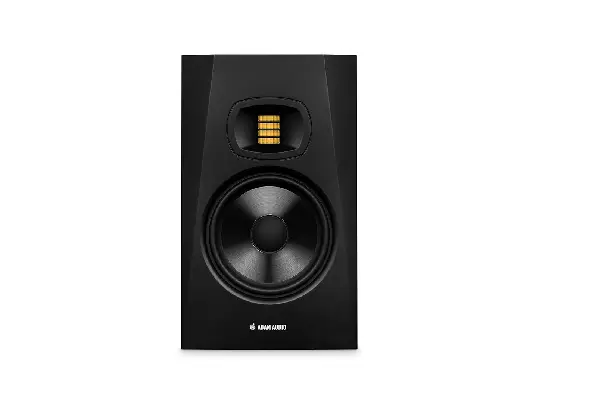
Adam Audio’s T7V represents the company’s effort to bring their signature ribbon tweeter technology and German engineering precision to a more accessible price point, and after several months of mixing on these monitors, I’m impressed by how much performance they’ve packed into this price range. The U-ART accelerated ribbon tweeter extends response to 25 kHz while maintaining the detailed, airy high-frequency character that Adam monitors are known for—there’s a refinement to the top end that makes these speakers feel more expensive than they actually are.
The 7-inch woofer employs Adam’s HexaCone design, which provides rigidity without excessive mass, resulting in tight, controlled bass response that remains articulate even during complex low-frequency passages. I’ve found the T7V particularly excellent for vocal-focused productions and acoustic instruments where detail retrieval and natural timbre reproduction are critical. The front-ported design offers more placement flexibility than rear-ported alternatives, though I still achieved the best results with the monitors positioned away from walls to minimize boundary reinforcement.
Pros:
- Ribbon tweeter provides extended high-frequency response with minimal fatigue
- Excellent value with performance characteristics typically found in more expensive monitors
- Front-ported design offers greater placement flexibility in challenging room environments
- Outstanding stereo imaging creates convincing spatial presentation
- Natural midrange character suitable for critical vocal and instrument balancing
Cons:
- Bass extension limited compared to monitors with 8-inch or larger drivers
- Power output may be insufficient for larger rooms or high SPL requirements
- Ribbon tweeter requires more delicate handling than traditional dome designs
- Limited acoustic adjustment options compared to more professional-focused models
Focal Alpha 80 Evo: French Character With Surprising Detail
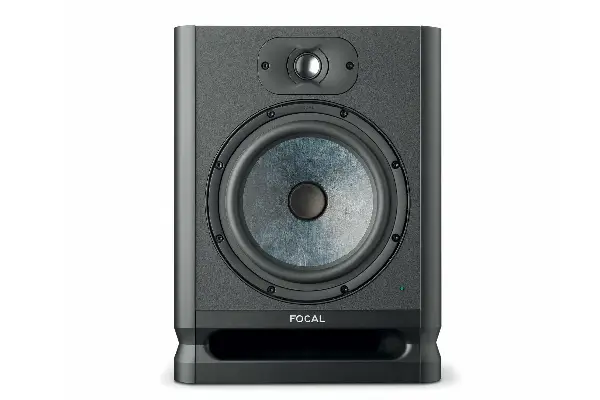
The Focal Alpha 80 Evo brings the company’s decades of loudspeaker expertise from the hi-fi world into the professional studio monitor realm, and the results combine musicality with the accuracy needed for critical mixing work. Focal’s Slatefiber cone technology employs a unique material combining recycled carbon fibers with fiberglass particles, creating a driver with excellent damping characteristics that minimize resonance while maintaining stiffness. The 8-inch woofer extends response down to 35 Hz, providing satisfying bass presence without requiring immediate subwoofer addition for most musical genres.
What distinguishes the Alpha 80 Evo from many competing monitors is the slightly warm, musical character that makes these speakers enjoyable for extended listening while maintaining sufficient accuracy for professional work. I’ve found this balance particularly valuable during creative production phases where I’m layering sounds and building arrangements—the Focal monitors inspire creativity rather than inducing the listener fatigue that overly analytical speakers can cause. The M-shaped inverted dome tweeter provides detailed high-frequency reproduction without excessive brightness, revealing cymbal nuances and vocal breaths without exaggerating sibilance.
The automatic standby function proved more useful than I initially expected, powering down the monitors after periods of inactivity and extending component life while reducing energy consumption. The bass reflex design requires some attention to placement—positioning too close to walls resulted in bass buildup that skewed my low-end decisions until I moved the speakers further into the room and adjusted the bass management controls accordingly.
Pros:
- Musical character maintains listenability during extended production sessions
- Excellent bass extension from 8-inch Slatefiber woofers with minimal distortion
- Unique cone technology provides natural midrange reproduction
- Automatic standby function conserves energy and extends component longevity
- Versatile performance across genres from electronic to acoustic productions
Cons:
- Slightly warm character may not suit engineers preferring maximum analytical precision
- Bass reflex port requires careful positioning to avoid room mode interactions
- Limited availability in some markets compared to more established studio brands
- Rear panel controls can be difficult to access depending on mounting configuration
Genelec 8030C: Finnish Engineering Excellence in Compact Form
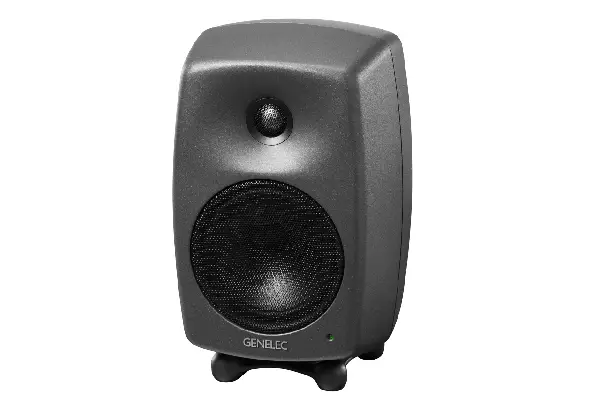
The Genelec 8030C demonstrates what decades of acoustic research and engineering refinement can achieve in a compact monitor format, delivering performance that belies the speaker’s modest 5-inch woofer. Genelec’s Directivity Control Waveguide (DCW) technology creates exceptionally consistent off-axis response, meaning the tonal balance remains stable even when I move around the mixing position—a characteristic that proves invaluable during collaborative sessions when multiple people need to hear accurate reproduction. The compact aluminum cabinet employs Genelec’s Minimum Diffraction Enclosure (MDE) design, minimizing edge diffraction that can cloud stereo imaging and frequency response.
The build quality reflects Genelec’s professional heritage, with robust construction designed for decades of reliable operation in demanding studio environments. The mounting versatility proved essential in my space—the integrated Iso-Pod stand isolation system and multiple threaded mounting points allowed precise positioning that optimized the monitors’ performance within my room’s acoustic constraints. While the price point places these monitors above entry-level options, the performance justifies the investment for serious production work.
Pros:
- Exceptional accuracy in compact form factor suitable for smaller studios
- Outstanding stereo imaging with stable off-axis response
- Professional build quality designed for decades of reliable operation
- Comprehensive room response controls allow optimization for various acoustic environments
- Consistent performance across wide range of monitoring levels
Cons:
- Limited bass extension requires subwoofer for full-range monitoring applications
- Premium pricing may exceed budgets for home studio producers
- Compact size limits maximum SPL capability compared to larger monitors
- Conservative aesthetic may not appeal to those preferring modern design language
Understanding Studio Monitor Technology and Selection
The studio monitor selection process involves more than identifying the “best” speaker—it requires matching monitor characteristics to your specific room acoustics, genre focus, and monitoring distance. The relationship between your monitoring environment and speaker choice matters enormously; untreated rooms with parallel walls and hard surfaces will create acoustic problems that no monitor can overcome through electronic processing alone.
Nearfield monitor design priorities differ significantly from hi-fi speakers or live sound reinforcement systems. The reduced listening distance in typical studio setups (typically 3-5 feet) means nearfield monitors can employ smaller drivers while still delivering adequate SPL and bass extension for critical mixing work. I learned this lesson after initially assuming larger drivers would always provide better performance—my first 8-inch monitors overwhelmed my small room with excessive bass that made accurate low-end decisions nearly impossible until I addressed acoustic treatment and positioning.
The active versus passive monitor debate has largely settled in favor of active designs for modern studio applications, and my experience confirms this trend makes sense for most users. Active monitors integrate amplification specifically designed and calibrated for the drivers, eliminating impedance matching concerns and providing optimized crossover characteristics. The convenience of not requiring separate amplification and speaker cables simplifies setup considerably, particularly when expanding to surround configurations or adding subwoofers that need to integrate seamlessly with main monitors.
Room Treatment: The Foundation For Accurate Monitoring
No discussion of studio monitors feels complete without addressing acoustic treatment—the most accurate speakers in the world cannot overcome fundamental room acoustic problems that color what you actually hear. I spent years fighting my room’s characteristics with EQ and monitor positioning before finally investing in proper bass traps and broadband absorption, and the improvement in clarity and accuracy exceeded the impact of previous monitor upgrades. Standing waves at room modes create massive peaks and nulls in bass response that make consistent low-end decisions essentially impossible without treatment.
First reflection points on the side walls, ceiling, and mixing console represent the minimum treatment needed for reasonably accurate monitoring in typical rectangular rooms. I measured first reflection locations using the mirror method—sitting at my mix position while someone moved a mirror along the walls until I could see the monitor reflections—then placed absorption panels at those positions. The improvement in stereo imaging and midrange clarity was immediately obvious, with the soundstage becoming more focused and three-dimensional.
Bass trapping proved more challenging due to the physical size required for effective low-frequency absorption, but the results transformed my ability to make accurate kick drum and bass decisions that translated to other systems. I positioned thick acoustic panels in room corners where bass modes accumulate most problematically, supplemented with membrane absorbers targeting specific problem frequencies identified through room measurement. When comparing reference tracks through quality headphones to monitor playback, the tonal balance now matches much more closely than before treatment.
Frequently Asked Questions
What size studio monitors should I choose for my home studio?
The optimal studio monitor size depends primarily on your room dimensions and monitoring distance rather than simply choosing the largest speakers possible. I’ve found 5-inch monitors work excellently in small bedrooms where you sit relatively close to the speakers, while 7-8 inch monitors suit medium-sized rooms with monitoring distances of 4-5 feet. Larger monitors can actually create more problems than they solve in compact, untreated spaces by exciting room modes and overwhelming the acoustic environment with excessive bass energy.
Do I need a subwoofer with my studio monitors?
Subwoofer necessity depends on your musical genre and the bass extension of your main monitors. I initially resisted adding a subwoofer, believing it would complicate my monitoring setup unnecessarily, but once I started producing bass-heavy electronic music, the subwoofer became essential for making confident decisions below 40 Hz. Proper integration requires careful calibration to avoid bass buildup—I spent considerable time adjusting crossover frequency, level matching, and phase alignment to create seamless transition between subwoofer and main monitors.
How should I position studio monitors in my room?
Studio monitor positioning significantly impacts the accuracy you’ll experience, starting with forming an equilateral triangle between your listening position and the two speakers. I position monitors so the tweeters align at ear height when seated at my mixing position, angled slightly inward so they point toward my head. Maintaining distance from walls prevents bass buildup from boundary reinforcement—I aim for at least 12 inches from any surface, though my room required even more distance to achieve balanced low-frequency response.
Are expensive studio monitors worth the investment for beginners?
The relationship between monitor price and mixing ability is less direct than many assume—I’ve heard excellent mixes created on modest monitors in well-treated rooms and problematic mixes from expensive monitoring in poor acoustic environments. Beginning producers benefit more from learning their monitors intimately than constantly upgrading equipment, though investing in decent monitors from the start prevents having to relearn mixing fundamentals when eventually upgrading from severely colored consumer speakers.
How do studio monitors differ from regular speakers?
Studio monitors prioritize accuracy and transparency over the excitement and energy that consumer speakers often emphasize through boosted bass and enhanced treble. Regular speakers often color the sound to make music more enjoyable, while studio monitors reveal mix problems honestly—including harsh frequencies, distortion, and imbalances that need correction. This honesty feels less flattering initially but proves essential for making mixing decisions that translate reliably across various playback systems.