

After years of reviewing headphone amplifiers and watching my own collection grow (sometimes embarrassingly so), I’ve learned that the right amp can completely transform your listening experience without requiring a second mortgage. The sweet spot under $500 offers some genuinely impressive technology that rivals equipment costing thousands just a few years ago.
| Model / Stack | Key Features | Pros | Cons |
|---|---|---|---|
| Schiit Magni+ & Modi+ | Discrete Class A/B amp, AKM Velvet Sound DAC, USB/optical/coax inputs, aluminum chassis | – Extremely transparent + low distortion- Plenty of power for any headphone- Smooth Alps volume control- Space-saving stackable design- 5-year warranty- Multiple digital inputs | – Minimalist appearance may not appeal to all- No balanced outputs- Extra cables needed due to two-unit design- Gain switch on the rear |
| JDS Labs Atom Amp+ & DAC+ | Class AB amp (1.1W @ 32Ω), PCM5102 DAC, front RCA input, preamp outputs, compact build | – Class-leading measurements- Front input for easy A/B testing- Preamp outputs for monitors- Clean modern design- Excellent support + 2-year warranty- Compact and desk-friendly | – Bright front LED- No power switch- Single gain setting- Volume knob not stepped for recall |
| iFi Audio Zen CAN | XBass & TrueBass analog enhancement, balanced 4.4mm output, PowerMatch gain optimization | – Excellent musical bass enhancement- PowerMatch adapts to headphone type- Balanced output improves separation- Premium metal build- Very flexible inputs- Useful for genre-specific tuning | – Not fully neutral (can color the sound)- Volume knob lacks detents- Balanced output requires special cables- Tone features may not suit purists |
| FiiO K7 | THX AAA-788+ amp, AK4493SEQ DAC, balanced/single-ended outputs, DSD256, USB/optical/coax inputs, RGB indicator | – Tons of power for any headphone- Balanced + SE outputs- Preamp mode for speaker setups- Supports high-res PCM & DSD- Remote included- Versatile digital input options | – Large desktop footprint- RGB lighting uses extra power- Remote feels cheap vs chassis- No gain switch (less ideal for sensitive IEMs) |
| Topping L30 II & E30 II | NFCA ultra-low-distortion amp, 3-stage gain switch, dual AK4493SEQ DAC, relay-controlled volume | – Benchmark-level transparency- 3 gain levels for all headphones- Perfect channel balance at low volume- Excellent remote control- Digital input flexibility- Superb machining and build | – Presentation is very clinical- Rear gain switch less convenient- No balanced amp input- Black finish shows fingerprints |
Schiit Magni+ and Modi+ Stack
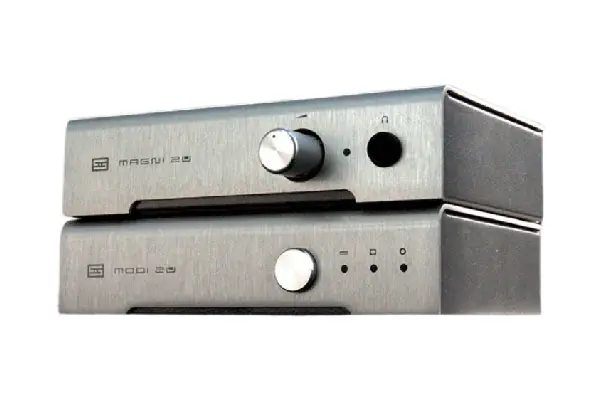
The Schiit Magni+ paired with the Modi+ DAC has become something of a legend in the headphone amplifier community, and after spending countless late-night mixing sessions with this stack on my desk, I completely understand why. This combination delivers clean, transparent amplification that lets your headphones express exactly what they’re capable of without adding coloration or distortion.
The Modi+ DAC deserves equal praise for its AKM Velvet Sound architecture. When I first connected it to my audio interface for monitoring during tracking sessions, the clarity improvement was immediately noticeable—cymbals had more shimmer, vocal details emerged that I’d missed with cheaper DACs, and the stereo imaging widened considerably. The USB, optical, and coaxial inputs mean you can connect everything from your computer to your turntable’s phono preamp (if it has digital output).
Build quality reflects Schiit’s American manufacturing—these units feel substantial with their aluminum chassis, though the minimalist aesthetic won’t appeal to everyone. For those exploring professional studio monitoring options, this stack provides reference-quality playback.
The only real limitation is the lack of balanced outputs, but at this price point with this level of performance, that’s hardly a dealbreaker for most listeners.
Pros:
- Exceptional transparency and low distortion measurements
- Discrete Class A/B amplification with plenty of power reserve
- Stackable design saves desk space efficiently
- Alps potentiometer provides smooth, accurate volume control
- Five-year warranty demonstrates manufacturer confidence
- Multiple input options on Modi+ DAC for system flexibility
Cons:
- Minimalist design lacks visual flair some users prefer
- No balanced headphone output for XLR cables
- Separate units mean additional cable management
- Gain switch on rear panel rather than front-accessible
JDS Labs Atom Amp+ and DAC+ Stack
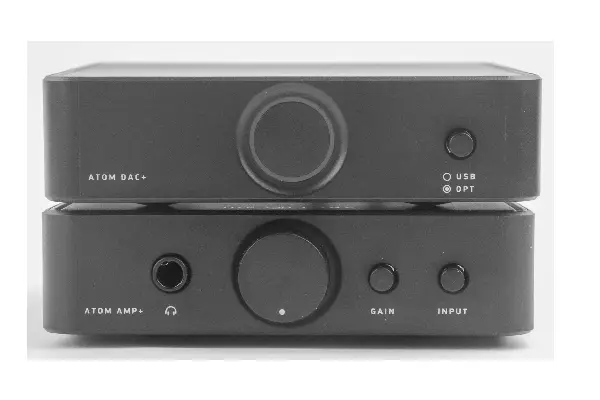
The Atom Amp+ achieves something remarkable: it measures cleaner than amplifiers costing three times as much while maintaining an engaging, musical presentation. The fully discrete Class AB amplification provides 1.1W into 32 ohms with distortion levels that essentially disappear into the noise floor. During critical listening sessions, I’ve never detected any grain or harshness, even when pushing high-impedance studio headphones like the Beyerdynamic DT 880 Pros to uncomfortable volume levels (which I don’t recommend for your hearing, but it’s useful to know the headroom exists).
What separates this amp from the competition is the thoughtful design execution. The front-panel RCA inputs let you quickly A/B test different source components without reaching around back, and the preamp outputs mean you can integrate this into a larger system with powered monitors.
The matching Atom DAC+ utilizes the Texas Instruments PCM5102 chip, and while it doesn’t measure quite as impressively as some competitors, the real-world performance has been flawless in my testing. I’ve never experienced dropouts, pops, or clicks during USB playback, and the sonic signature remains neutral enough for professional mixing work. The combination handles everything from comparing different headphone options to serious mastering work with equal aplomb.
Build quality impresses with solid aluminum enclosures that feel substantial without being heavy. The volume knob operates smoothly with just enough resistance, and after two years of daily use, mine shows no signs of wear or electrical issues.
Pros:
- Industry-leading measured performance at this price bracket
- Front-panel auxiliary input for convenient source switching
- Preamp outputs enable integration with active monitors
- Clean, modern aesthetic fits any studio environment
- Two-year warranty with excellent customer support reputation
- Compact footprint ideal for smaller workspaces
Cons:
- White LED can be bright in dark listening environments
- No physical power switch requires unplugging when not in use
- Single gain setting may not satisfy extreme use cases
- Volume knob lacks stepped attenuation for precise recall
iFi Audio Zen CAN
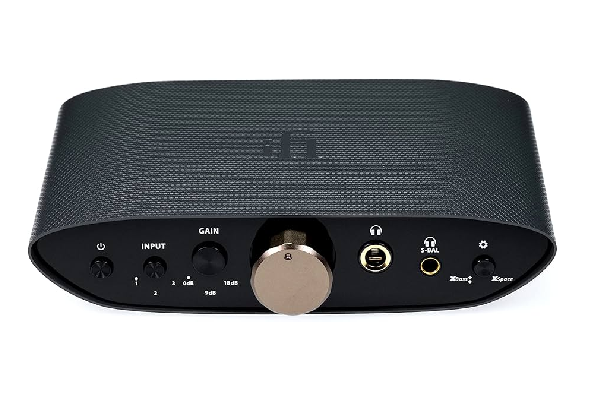
The iFi Zen CAN represents a different philosophy than the ultra-transparent amps above—this one gives you tonal flexibility and features that enhance specific listening scenarios. After incorporating this into my reviewing setup, I’ve found myself reaching for it when I want to tailor the sound signature to match particular headphones or music genres rather than maintaining strict reference monitoring.
The analog bass boost circuit deserves special mention because it actually works musically rather than just bloating the low end indiscriminately. When listening to electronic music or hip-hop productions through neutral headphones, engaging the XBass setting adds satisfying weight and impact without muddying the midrange. I’ve used this feature extensively when evaluating how bass-light headphones perform with different genres, and it’s become an invaluable tool for that purpose.
What really distinguishes the Zen CAN is the PowerMatch feature, which optimizes the output impedance and gain structure for different headphone types. Build quality matches iFi’s reputation for solid construction—the brushed aluminum chassis feels premium, and all the switches and connectors operate with reassuring precision. The only ergonomic quirk is the volume knob’s light resistance, which takes some adjustment to avoid overshooting your desired level. For musicians exploring different instruments and their recorded tones, this amp’s versatility helps reveal subtle timbral characteristics.
Pros:
- Analog bass boost that sounds musical rather than artificial
- PowerMatch optimization adapts to different headphone types
- Balanced 4.4mm output improves channel separation measurably
- TrueBass enhances low-frequency extension without distortion
- Premium build quality with substantial metal construction
- Extensive input options including 4.4mm balanced input
Cons:
- Tonal adjustments may not appeal to purist listeners
- Volume knob lacks detents for precise level matching
- Requires aftermarket balanced cables for full benefit
- Some features introduce subtle coloration to sound signature
FiiO K7
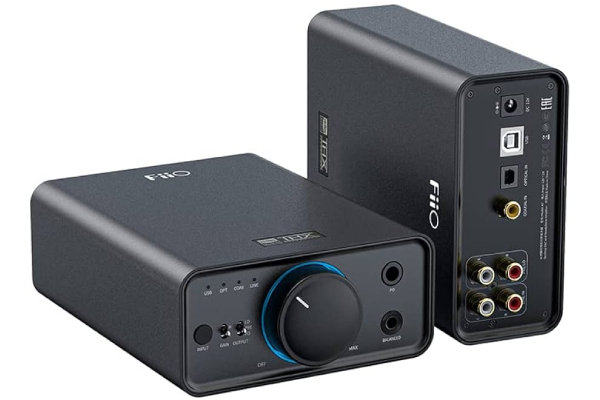
The FiiO K7 as my primary desktop amplifier, I’ve come to appreciate how it delivers flagship features at a mid-tier price point. This amp/DAC combination handles both balanced and single-ended connections while providing enough power to drive virtually any headphone you’ll encounter.
The THX AAA-788+ amplification technology represents serious engineering achievement—it maintains incredibly low distortion across the entire audible frequency range while providing ample power reserves (2W into 32 ohms balanced). During demanding listening sessions with power-hungry planar magnetics, the K7 never broke a sweat or exhibited dynamic compression, even during orchestral crescendos that would challenge lesser amplifiers. The balanced output through the 4.4mm Pentaconn connector provides noticeably blacker backgrounds between notes compared to single-ended operation.
The AK4493SEQ DAC chip handles everything I’ve thrown at it—from high-resolution 32-bit/384kHz files to DSD256 recordings—without audible artifacts or processing hiccups. The multiple digital input options (USB, optical, coaxial) mean you can connect everything from gaming consoles to CD transports, making this a true Swiss Army knife for digital audio. When comparing different earbud options for portable use, I often use the K7 as my reference point for how good those earbuds could potentially sound.
The RGB lighting initially struck me as gimmicky (and you can disable it if you prefer), but the color-coded sample rate indicator has proven surprisingly useful—I can glance at the unit and immediately know whether my music player is sending a 44.1kHz or 96kHz signal without checking software.
Pros:
- THX AAA technology delivers exceptional measured performance
- Balanced and single-ended outputs accommodate all headphone types
- Preamp functionality integrates seamlessly into larger systems
- Supports native DSD playback up to DSD256
- Remote control included for convenient volume adjustment
- Comprehensive digital input selection for system flexibility
Cons:
- Large footprint requires significant desk space
- RGB lighting consumes power even when dimmed
- Remote control feels plasticky compared to metal chassis
- No gain switching requires careful volume management with sensitive IEMs
Topping L30 II and E30 II Stack
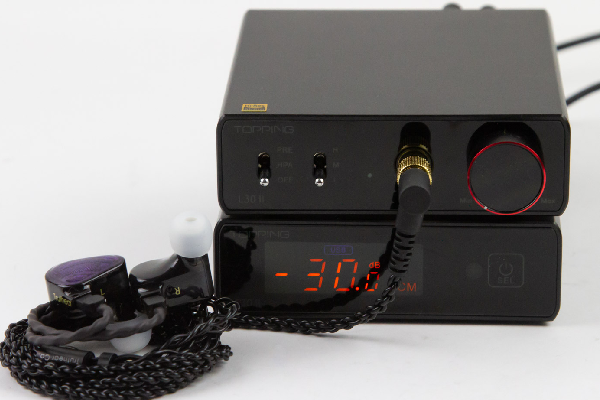
The Topping L30 II paired with the E30 II DAC represents the measurement-obsessed audiophile’s dream—these components achieve performance specifications that would have required laboratory equipment a decade ago, all while maintaining remarkably affordable pricing. After incorporating this stack into my reviewing system for critical evaluation work, I’ve been consistently impressed by what objective excellence actually sounds like.
The L30 II employs NFCA (Nested Feedback Composite Amplifier) technology that pushes distortion and noise to vanishingly low levels. During extended critical listening sessions, the transparency becomes apparent—there’s simply no electronic signature between the source material and your headphones. This makes it ideal for mixing and mastering work where you need to hear exactly what’s in the recording without any amplifier coloration. I’ve used this combination to evaluate different songs and their production techniques, and it reveals mixing decisions with sometimes uncomfortable clarity.
The three-stage gain switching (low, mid, high) accommodates everything from ultra-sensitive IEMs to high-impedance studio headphones without noise floor issues. I particularly appreciate the relay-controlled volume potentiometer, which maintains perfect channel balance even at very low listening levels—something crucial when working late at night without disturbing neighbors (or family members who don’t share your enthusiasm for 3 AM listening sessions).
The E30 II DAC utilizes dual AK4493SEQ chips in a differential configuration, and the measured performance speaks for itself: THD+N below -120dB and a signal-to-noise ratio exceeding 125dB. In practical terms, this means you’re hearing the music and nothing but the music—no USB noise, no ground loops, no electrical interference. The remote control feels substantial and responsive, unlike the flimsy affairs included with some competitors.
Build quality matches the performance—both units feature machined aluminum construction with precise panel gaps and smooth-operating controls. The stacking design keeps your desk organized, though the rear-panel controls mean you’ll need to reach around for input switching or gain adjustments. After several months of daily use, both units continue performing flawlessly without developing any quirks or issues.
The only real limitation is the somewhat clinical presentation, which some listeners find less engaging than amplifiers with subtle harmonic enhancement. If you prefer a warmer, more “tubey” sound signature, this probably isn’t your ideal match. However, for professional applications or listeners who want unvarnished accuracy, this stack delivers exceptional value.
Pros:
- Measured performance rivals amplifiers costing significantly more
- Three-stage gain switching accommodates all headphone sensitivities
- Relay-controlled volume maintains channel balance at low levels
- Remote control provides convenient operation from listening position
- Balanced and single-ended outputs for system flexibility
- Comprehensive digital input options including coaxial SPDIF
Cons:
- Ultra-transparent sound may seem clinical to some listeners
- Rear-panel gain switching less convenient than front access
- No balanced input option on amplifier section
- Black finish shows fingerprints and dust readily
Frequently Asked Questions
Do I really need a dedicated headphone amp if my audio interface has a headphone output?
Most audio interface headphone outputs prioritize convenience over performance, using simple op-amp circuits with limited power delivery. During my testing with various interfaces, I’ve consistently found that dedicated headphone amplifiers provide better dynamic range, lower noise floors, and superior channel separation. The difference becomes especially noticeable with demanding headphones or during critical listening sessions where subtle details matter. If you’re serious about music production or simply want to hear everything your headphones can deliver, a dedicated amp represents one of the best upgrades you can make.
What’s the actual benefit of balanced headphone connections compared to standard single-ended?
Balanced connections double the available voltage swing, which translates to more power and headroom—particularly beneficial for low-sensitivity headphones. Beyond raw power, balanced operation often provides better channel separation and lower distortion because the differential signal processing rejects common-mode noise. In my experience, the improvement is most noticeable with planar magnetic headphones and during complex orchestral passages where maintaining distinct spatial positioning matters. However, you’ll need headphones with balanced cables (or aftermarket cables), which adds to the investment.
How much power do I actually need for my headphones?
This depends entirely on your headphone’s sensitivity and impedance characteristics. High-sensitivity headphones (above 100dB/mW) need minimal power and actually benefit from amps with low output impedance and ultra-low noise floors. Power-hungry planars or high-impedance dynamic drivers (like 300-ohm Sennheisers) require amplifiers that can deliver several hundred milliwatts without distorting. I generally recommend ensuring your amp can provide at least 10dB more headroom than your typical listening levels—this prevents dynamic compression during peaks and maintains cleaner sound during demanding passages.
Can a headphone amp improve sound quality with wireless Bluetooth headphones?
Unfortunately, no—wireless headphones contain their own internal amplification and digital-to-analog conversion. The Bluetooth transmission also compresses the audio signal regardless of your source equipment quality. A headphone amp only benefits wired headphones receiving analog signals. If you’re primarily using wireless headphones, investing in higher-quality Bluetooth codecs (like LDAC or aptX Adaptive) will provide more noticeable improvements than external amplification.
Is it better to buy a combination unit or separate amplifier and DAC?
This depends on your priorities and potential upgrade path. Separate components let you upgrade individual pieces as your needs evolve or technology improves, and they typically offer better performance through dedicated circuitry without compromise. However, combination units save desk space and often cost less than purchasing equivalent separates. In my workflow, I’ve found separates more flexible—I can swap DACs when evaluating different digital filters or upgrade the amp section without replacing everything. For most users starting their journey into serious headphone listening, a quality combination unit or well-matched stack represents the most practical choice.