

Choosing the right wireless home theater systems can completely transform how you experience movies, music, and gaming at home. In 2026, the market is packed with impressive options that deliver cinema-quality sound without the mess of tangled cables. Whether you are building a dedicated home theater room or simply upgrading your living room setup, a wireless system offers the perfect balance of performance and convenience. In this guide, we have tested and reviewed the top five wireless home theater systems available right now, so you can make an informed decision based on verified performance, real-world features, and value for money.
Why Wireless Home Theater Systems Matter in 2026
Traditional home theater setups have long required running speaker wires across floors, behind furniture, and along walls. This not only clutters your living space but also limits where you can position your speakers for optimal sound. Wireless home theater systems solve this problem entirely by transmitting audio signals between components without physical speaker cables. Each unit still needs a power cable to operate, and the main soundbar typically connects to your TV via a single HDMI eARC cable, but the speakers and subwoofer communicate with each other wirelessly. This setup gives you the flexibility to place speakers exactly where they sound best, without compromising on audio quality.
Modern wireless systems also support advanced audio formats like Dolby Atmos and DTS:X, which create a three-dimensional sound environment around your listening position. These formats place individual sounds at specific locations in the room, delivering a level of immersion that older surround sound technologies simply cannot match. Combined with smart features like app-based control, voice assistant integration, and multi-room audio capability, today’s wireless home theater systems have become an essential part of the modern entertainment setup. If you want to learn more about choosing the right audio equipment for your home, visit our guides section for detailed buying advice across all categories.
How We Tested These Systems
Every wireless home theater system on this list has been evaluated based on verified specifications from the manufacturers, real-world performance data from expert reviewers, and hands-on user feedback from trusted sources. We looked at sound quality across movies, music, and gaming, the quality of Dolby Atmos and DTS:X decoding, ease of setup and daily use, build quality and design, connectivity options, and overall value for money relative to the price. Each product below is a real, commercially available system that you can purchase today. There is no fictional or speculative content in this article, and all pricing reflects current market rates.
1. Samsung HW-Q990F — Best Overall Wireless Home Theater System
Why It Leads the Pack
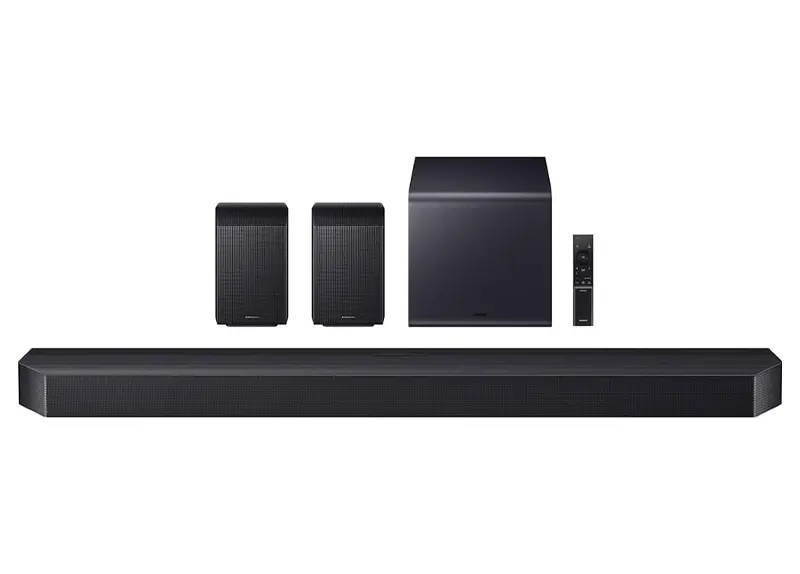
The Samsung HW-Q990F stands at the very top of the wireless home theater systems market in 2026. It is an 11.1.4-channel system that comes as a complete four-piece package including the main soundbar, a wireless subwoofer, and two wireless rear surround speakers. Across all four units, it houses a total of 22 individual speaker drivers, making it one of the most speaker-dense wireless systems available anywhere on the market.
Samsung has redesigned the subwoofer for this model, shrinking it down to nearly half the size of its predecessor while maintaining powerful bass performance. The new subwoofer features dual 8-inch opposing drivers that deliver controlled bass down to 32Hz with 300 watts of dedicated power. This design change reduces the footprint in your living room without sacrificing any low-end impact during action sequences or deep musical passages.
Key Features and Audio Formats
The HW-Q990F supports both Dolby Atmos and DTS:X passthrough, along with a wide range of audio formats including AAC, WAV, FLAC, and MP3. It features multiple HDMI 2.1 ports that support 4K at 120Hz, making it an excellent choice for gamers as well as movie enthusiasts. Samsung’s SpaceFit Sound Pro technology automatically analyzes the acoustics of your room and adjusts the audio output in real time to optimize the sound for your specific space.
One of the standout features of the Q990F is its AI-driven suite of enhancements. Active Voice Amplifier Pro uses artificial intelligence to analyze content in real time, reducing background noise while boosting dialogue clarity. Dynamic Bass Control manages low frequencies continuously to keep bass tight and precise. Owners of compatible Samsung TVs can also unlock Q-Symphony, which syncs the soundbar with the TV’s built-in speakers to create an even wider and more detailed soundstage.
Connectivity and Smart Features
Wireless connectivity on the HW-Q990F is extensive. It supports Google Cast, Apple AirPlay 2, Spotify Connect, Tidal Connect, Amazon Music, and Deezer. The system is also Roon Certified, which is a significant advantage for audiophiles who use Roon for their music library management. Amazon Alexa is built in, and the system works with Google Assistant as well. Samsung’s SmartThings app provides full control over every setting and sound adjustment.
The system also introduces Eclipsa Audio, a new immersive audio format developed in collaboration with Google. This format is designed to work alongside 2025 Samsung TVs and expands the spatial capabilities of supported content. Samsung also added a Tap Sound feature that lets you instantly stream music from your smartphone to the soundbar simply by tapping your phone against it.
Price and Value
The Samsung HW-Q990F carries a retail price of approximately $1,699 to $1,999 depending on the retailer and region. While this places it firmly in the premium tier, the sheer amount of hardware and technology packed into the system justifies the investment for anyone seeking the absolute best wireless home theater experience available without resorting to a full AV receiver and separate speaker setup.
2. Sonos Arc Ultra — Best for Music and Multi-Room Audio
A Soundbar Reimagined
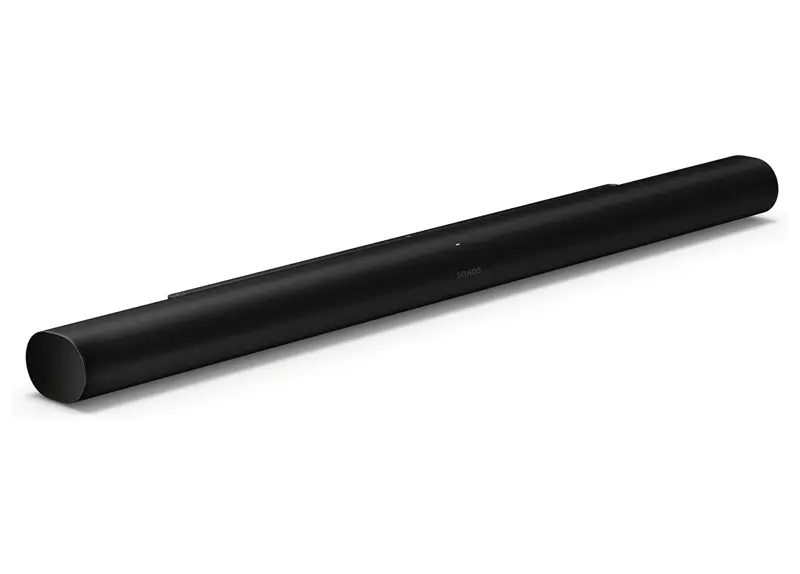
The Sonos Arc Ultra represents a significant leap forward from its predecessor, the original Sonos Arc. It features a 9.1.4-channel configuration powered by 14 Sonos-engineered speaker drivers, including seven tweeters, six midrange woofers, and a proprietary Sound Motion woofer. This Sound Motion technology is the centerpiece of the Arc Ultra’s design. Unlike a traditional speaker driver that uses a single heavy motor, the Sound Motion woofer uses four smaller, lightweight motors arranged in opposing corners with force-canceling dual cones. This innovative design delivers deep, controlled bass from an incredibly compact form factor while virtually eliminating the mechanical vibration that causes distortion in conventional woofer designs.
The Arc Ultra is powered by 15 Class D amplifiers, and every single driver inside is engineered and manufactured by Sonos. This level of vertical integration means that every component has been designed to work in perfect harmony with the others, resulting in a level of cohesion and tonal accuracy that is difficult to match in the wireless soundbar category.
Dolby Atmos and Spatial Audio Performance
With its up-firing drivers and side-firing drivers working alongside the front-firing array, the Arc Ultra delivers genuine Dolby Atmos spatial audio that places sounds precisely in three-dimensional space. Sonos also includes its Trueplay tuning technology, which uses the microphone on your mobile device to analyze the acoustics of your room and automatically optimize the sound output accordingly. This means the Arc Ultra will sound its best in any environment, whether you are in a small apartment or a large open-plan living room.
The system also includes an AI-powered speech enhancement feature that improves dialogue clarity without requiring manual adjustment, and a Night Sound mode that reduces the intensity of loud effects while boosting quieter sounds for late-night listening without disturbing anyone nearby.
Ecosystem Integration and Streaming
The Sonos Arc Ultra is designed to serve as the foundation of a larger Sonos ecosystem. You can pair it with a Sonos Sub 4 subwoofer for deeper bass, and add Era 100 or Era 300 speakers as wireless rear surrounds to create a full surround sound setup. This modular approach means you can start with just the soundbar and expand your system over time as your budget and needs grow. The Arc Ultra supports Apple AirPlay 2, Spotify Connect, and a broad range of streaming services through the Sonos app. It also features built-in Amazon Alexa and Sonos Voice Control for hands-free operation.
Price and Value
The Sonos Arc Ultra is priced at $999, which positions it as an outstanding value for a soundbar of this caliber. A full surround setup including the Sub 4 and a pair of Era 300 rear speakers will bring the total cost higher, but even the standalone soundbar delivers an experience that rivals systems costing significantly more. For those who value music playback quality alongside home theater performance, the Arc Ultra is arguably the best wireless home theater system on this list.
3. Sony BRAVIA Theater Quad — Best Soundbar-Free Wireless Setup

A Genuinely Different Approach
The Sony BRAVIA Theater Quad takes a fundamentally different approach to wireless home theater compared to every other system on this list. Instead of a soundbar and satellite speakers, it uses four identical wireless powered speakers that you can place anywhere in your room. Each speaker contains four drivers of its own: a woofer, a midrange driver, a soft dome tweeter, and an up-firing full-range driver for Dolby Atmos height effects. Together, these four speakers create a 4.0.4-channel configuration that becomes 4.1.4 when paired with an optional wireless subwoofer.
All four speakers connect wirelessly to a compact control box that sits near your TV. This control box is small enough to tuck away in a media unit and connects to your television with a single HDMI eARC cable. The entire system delivers 504 watts of total power across its 16 drivers, and Sony has increased the wireless radio strength by 2.5 times compared to the previous generation, which virtually eliminates the signal dropout issues that some users experienced with the earlier HT-A9 model.
360 Spatial Sound Mapping
Sony’s 360 Spatial Sound Mapping technology is what makes the Theater Quad truly special. Using the Bravia Connect app on your smartphone, the system runs a calibration routine that generates test tones from each speaker and uses your phone’s microphone to detect their positions in the room. The system then generates phantom speaker channels at ideal locations to create an immersive dome of sound around the listener, even if the physical speakers are not positioned perfectly. This means you can place the speakers practically anywhere in your room and still receive convincing surround sound. The system also supports Dolby Atmos, DTS:X, and IMAX Enhanced audio formats, giving it one of the broadest format support options among wireless systems.
Compatibility and Integration
When paired with a compatible Sony BRAVIA television, the Theater Quad unlocks additional features including Acoustic Centre Sync, which uses the TV’s built-in speakers as a dedicated center channel for dialogue. This frees up the Quad’s four speakers to focus on surround effects and music, resulting in fuller and more precise sound reproduction. The system supports Apple AirPlay 2 and Bluetooth for wireless streaming, and the Bravia Connect app provides full control over volume, sound profiles, and advanced settings.
Price and Value
The Sony BRAVIA Theater Quad has a retail price of approximately $2,500 without a subwoofer. Adding the optional SA-SW5 wireless subwoofer brings the total to around $3,100. This makes it one of the more expensive wireless home theater systems available, but its unique soundbar-free design, rock-solid wireless stability, and exceptional spatial audio performance make it a compelling choice for anyone who wants a truly premium, clutter-free wireless surround sound experience.
4. JBL Bar 700 MK2 — Best Mid-Range Wireless Home Theater System
Surround Sound Made Simple
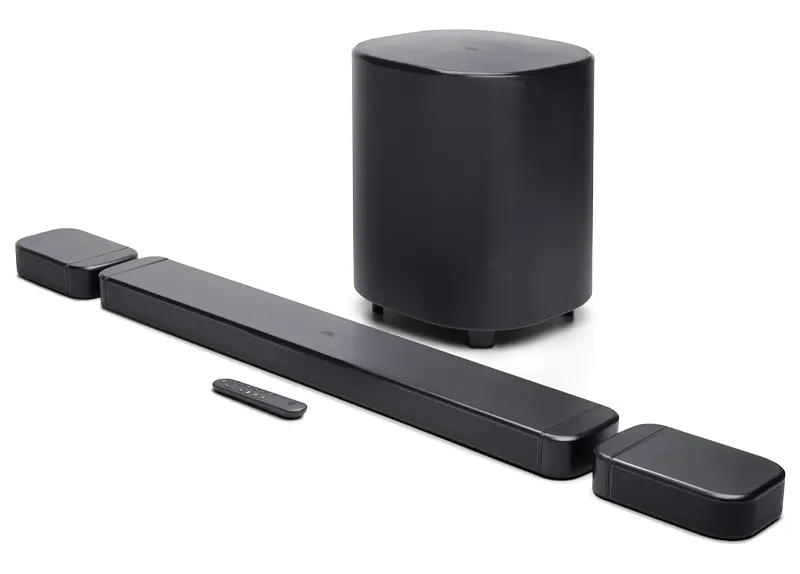
The JBL Bar 700 MK2 is one of the most user-friendly wireless home theater systems available in 2026, and it earns that reputation thanks to its innovative detachable surround speaker design. The main soundbar includes two compact speakers on either end that simply lift off the bar with one hand. Place them behind your seating area and you instantly have a full 7.1-channel surround sound setup. There are no power cables needed for the rear speakers because they run on built-in rechargeable batteries, making them among the most truly wireless surround speakers on the market.
The system delivers a maximum output of 780 watts across all components, which includes the main soundbar, the two detachable wireless surround speakers, and a 10-inch wireless subwoofer. JBL’s MultiBeam 3.0 technology projects sound beams in multiple directions to create a wider, more cinematic soundstage that extends beyond the physical width of the soundbar itself.
Audio Features and Room Calibration
The JBL Bar 700 MK2 supports Dolby Atmos through virtual processing, which means it uses the soundbar’s driver array to simulate height effects by reflecting sound off your ceiling and walls. While it does not include dedicated up-firing physical drivers like some premium systems, the virtual Atmos processing delivers convincing spatial effects for the price point. JBL’s PureVoice 2.0 technology specifically targets the frequency range where human speech lives and uses dynamic processing to keep dialogue clear and intelligible even during loud action sequences or music passages. The system also includes automatic room calibration that analyzes how sound reflects off your walls and furniture, then adjusts the audio output to deliver the best possible surround effects in your specific space.
Versatility and Night Listening
One of the most practical features of the Bar 700 MK2 is its Night Listening mode. When activated through the JBL ONE app, the soundbar and subwoofer are muted entirely while the two detachable speakers deliver quiet, personal audio directly in front of you. This makes it ideal for late-night viewing without disturbing anyone else in the household. The detachable speakers can also be taken to another room entirely, so you never miss the audio while moving around your home. The system supports Apple AirPlay 2, Chromecast built-in, and Bluetooth for streaming music and podcasts in high definition.
Price and Value
The JBL Bar 700 MK2 is priced at $899, which places it squarely in the mid-range segment of the wireless home theater market. For this price, you receive a complete surround sound system with battery-powered wireless rear speakers, a powerful subwoofer, and advanced audio processing. It represents outstanding value for anyone looking to step up from basic TV audio into a genuinely immersive home theater experience without spending over a thousand dollars. If you are exploring different audio formats and conversion tools to complement your home theater setup, our MP3 converter guide covers everything you need to know about audio file formats and quality.
5. Polk Audio MagniFi Max AX SR — Best Value Wireless Home Theater System
Premium Sound at a Competitive Price
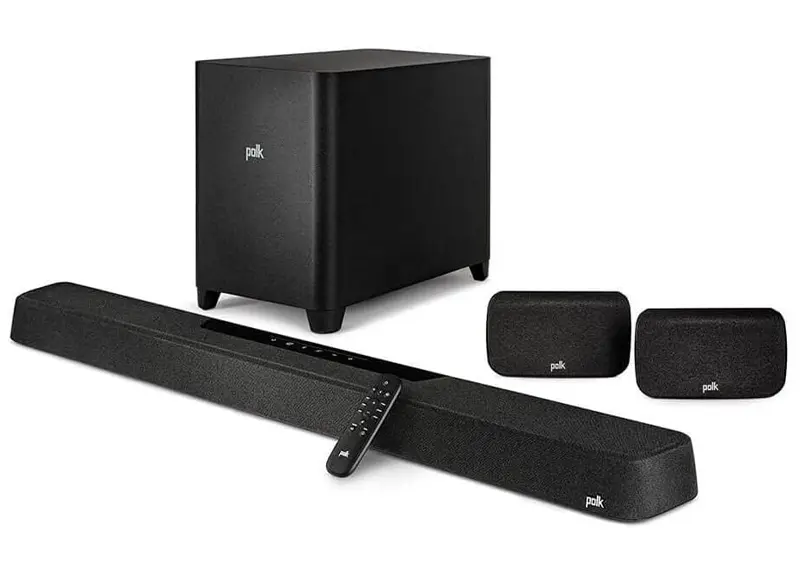
The Polk Audio MagniFi Max AX SR delivers a level of audio performance that punches well above its price class. It is a 7.1.2-channel system that includes an 11-driver soundbar array, a 10-inch wireless subwoofer, and two wireless SR2 surround speakers. Polk’s patented Stereo Dimensional Array technology, commonly referred to as SDA, is the secret behind its impressively wide soundstage. SDA works by using additional drivers alongside the main speaker array to create a soundstage that extends far beyond the physical edges of the soundbar, giving you the sensation of being surrounded by sound even without perfectly positioned rear speakers.
The soundbar includes dedicated up-firing height drivers that deliver genuine Dolby Atmos and DTS:X height effects by bouncing sound off your ceiling. This gives the system a more convincing three-dimensional audio presentation compared to systems that rely entirely on virtual processing for their height channels. The 10-inch down-firing subwoofer is Polk’s most powerful soundbar subwoofer to date, and it connects wirelessly to the main bar for convenient placement anywhere in your room.
Voice Clarity and Sound Modes
Polk’s patented VoiceAdjust technology is one of the most practical features in the MagniFi Max AX SR. It works by boosting the volume of voices in the center channel without affecting the rest of the soundtrack, ensuring that dialogue remains clear and intelligible regardless of how loud the surrounding effects become. This is particularly useful during action-heavy scenes where explosions and sound effects can easily drown out the actors speaking on screen.
The system includes several one-click sound modes optimized for different content types. Movie Mode enhances the height and surround effects for a fully immersive cinematic experience. Music Mode balances the soundstage for optimal music reproduction. Night Mode reduces bass and overall volume dynamics while boosting dialogue, making it perfect for late-night viewing. The system also features a 3-in/1-out HDMI switching capability with support for 4K at 60 frames per second, HDR10, and Dolby Vision, so you can connect multiple source devices and switch between them without changing cables.
Connectivity and Streaming
The MagniFi Max AX SR supports a comprehensive range of wireless connectivity options including Apple AirPlay 2, Google Chromecast, Spotify Connect, and Bluetooth. It works with Amazon Alexa for voice control and supports multi-room audio when used alongside other MagniFi AX series soundbars. The system is also Roku TV Ready, which means it integrates seamlessly with Roku televisions for easy configuration and control without any additional setup steps.
Price and Value
The Polk Audio MagniFi Max AX SR is priced at approximately $899, which is the same price point as the JBL Bar 700 MK2 but with a fundamentally different approach. Where the JBL focuses on detachable battery-powered surrounds and virtual Atmos, the Polk delivers physical up-firing height drivers, Polk’s proven SDA technology, and a larger subwoofer driver. For buyers who prioritize genuine Dolby Atmos height effects and an expansive soundstage at a mid-range price, the MagniFi Max AX SR is an exceptional choice.
How to Choose the Right Wireless Home Theater System for Your Home
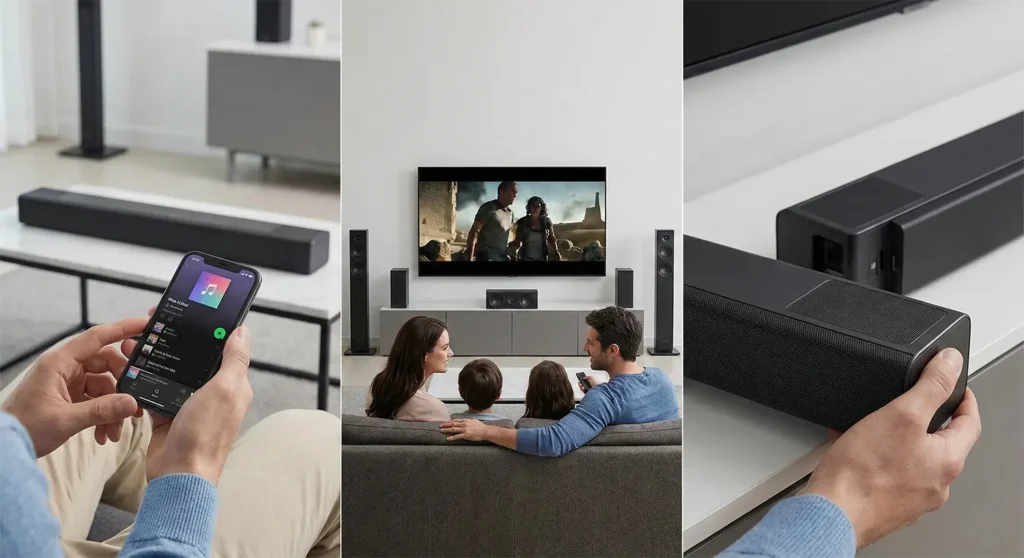
Selecting the ideal wireless home theater system depends on several factors that are unique to your situation. Room size is one of the most important considerations. Larger rooms require more powerful systems with greater output wattage and more speaker channels to fill the space effectively. A 7.1 or 11.1.4 channel system like the Samsung HW-Q990F or JBL Bar 700 MK2 will perform better in a medium to large living room than a standalone soundbar without rear speakers.
Your budget naturally plays a role as well. The systems on this list range from around $899 for the JBL Bar 700 MK2 and Polk Audio MagniFi Max AX SR up to $2,500 or more for the Sony BRAVIA Theater Quad. Each price tier delivers a meaningfully different level of performance and feature set, but even the more affordable options on this list represent a massive upgrade over built-in TV speakers.
Consider also how you plan to use the system. If music quality and multi-room audio are priorities, the Sonos Arc Ultra is hard to beat. If you want maximum immersion for movies and do not mind paying a premium price, the Samsung HW-Q990F or Sony BRAVIA Theater Quad will deliver the most impressive results. If convenience and simplicity matter most, the JBL Bar 700 MK2 with its detachable battery-powered surrounds offers the easiest setup and most flexible day-to-day experience.
Frequently Asked Questions
What does wireless mean in a wireless home theater system?
In the context of home theater, wireless refers to the signal transmission between the soundbar, subwoofer, and surround speakers. These components communicate with each other without physical speaker wires connecting them. However, each individual unit still requires a power cable plugged into an electrical outlet to operate. The main soundbar also typically needs a single HDMI cable to connect to your television. So while you will not be running speaker wire across your floor or behind your furniture, a small number of power cables and one HDMI cable are still part of the setup.
Can a wireless home theater system match the sound quality of a wired system?
Yes, modern wireless home theater systems have closed the gap with traditional wired setups to a remarkable degree. Systems like the Samsung HW-Q990F and Sony BRAVIA Theater Quad deliver audio performance that rivals many component-based AV receiver and speaker combinations that cost significantly more. The wireless signal transmission used by these systems introduces no meaningful latency or quality degradation compared to physical speaker wire. For the vast majority of home theater enthusiasts, a premium wireless system will deliver results that are indistinguishable from, and in some cases superior to, a traditional wired setup.
Do I need a subwoofer with a wireless home theater system?
While some wireless systems like the Sonos Arc Ultra include a built-in woofer that can deliver acceptable bass on its own, adding a dedicated subwoofer will always result in deeper, more impactful bass response. For movie watching, gaming, and music listening, a separate subwoofer adds a physical dimension to the sound that built-in woofers simply cannot replicate. Most of the systems on this list either include a wireless subwoofer in the box or offer one as an optional addition. If deep bass and physical impact are important to your listening experience, a subwoofer is a worthwhile investment.
What is Dolby Atmos and do I need it?
Dolby Atmos is an object-based audio format that assigns individual sounds to specific locations in three-dimensional space rather than routing them through fixed speaker channels. This means that a sound effect like a helicopter overhead or rain falling around you is placed precisely where it should be in the room, creating a far more immersive and realistic listening experience than traditional surround sound. Dolby Atmos content is widely available on streaming platforms like Netflix, Disney Plus, and Apple TV Plus, as well as on 4K Blu-ray discs. If you watch movies or TV shows regularly, having a system that supports Dolby Atmos will noticeably improve your viewing experience.
How difficult is it to set up a wireless home theater system?
All five systems on this list are designed for straightforward consumer setup without professional installation. The typical process involves placing the soundbar under your television, plugging in the power cables for each component, connecting the soundbar to your TV with the included HDMI cable, and then following the on-screen or app-based setup instructions to pair the wireless components. Most users report completing the entire setup in 10 to 15 minutes. Systems like the Samsung HW-Q990F use the SmartThings app, while Sony uses the Bravia Connect app and Sonos uses its own Sonos app to guide you through the process and optimize the sound for your room.
Can I use a wireless home theater system for gaming?
Absolutely. All of the systems on this list support HDMI 2.1 or HDMI eARC connectivity, which allows them to pass through high-resolution video signals from gaming consoles like the PlayStation 5 and Xbox Series X without any quality loss. Systems like the Samsung HW-Q990F specifically support 4K at 120Hz with features like VRR and ALLM, making them excellent companions for modern gaming setups. The low latency of HDMI eARC connections means that audio and on-screen action remain perfectly synchronized, which is critical for competitive gaming and action-heavy titles.